The Change Saturation Map: How to See When Your Organization Is Carrying Too Much Change
Most transformation plans look reasonable in isolation. But employees experience every initiative together. Learn how to map change saturation before adoption breaks down.
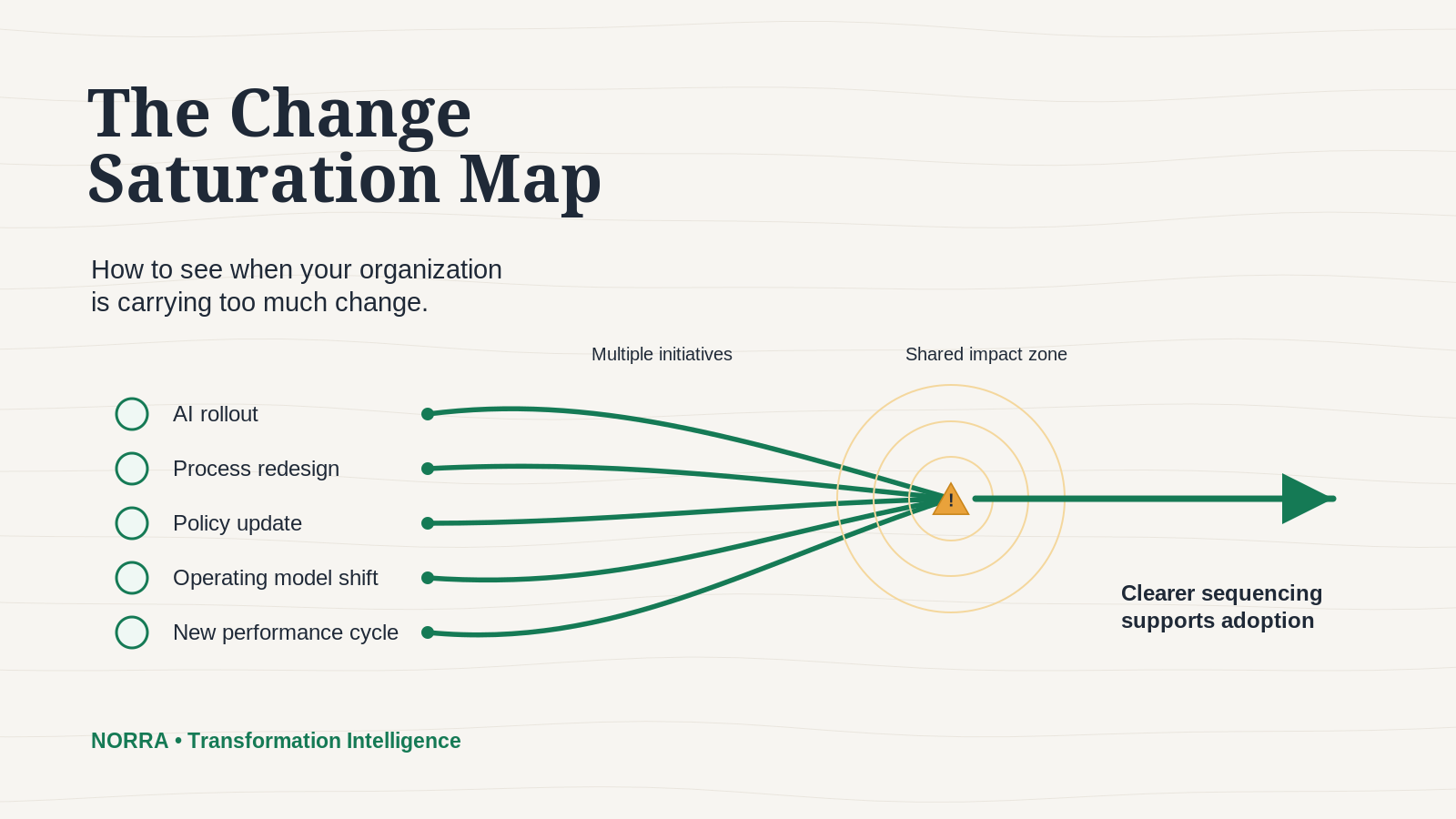
Most transformation plans look reasonable in isolation. A new AI tool. A revised operating model. A process redesign. A policy update. A leadership restructuring. A new performance cycle. A customer experience initiative.
Each one has a business case, a sponsor, a timeline, a deck, and a clear explanation for why it matters. But employees do not experience change one initiative at a time. They experience all of it together.
That is where many transformation plans start to break down. Not because the strategy is wrong. Not because the communication was badly written. Not because people are inherently resistant. They break down because the organization is carrying more change than leaders can see.
This is the problem of change saturation. Change saturation happens when the combined load of transformation exceeds the organization’s ability to absorb, interpret, and act on it. It is not just “too much change” in a general sense. It is too much change landing on the same teams, managers, workflows, and decision points at the same time.
The issue is not that organizations should stop changing. The issue is that leaders need a better way to see where change is accumulating before adoption starts to fracture. That is what the Change Saturation Map is for.
The problem: initiatives are planned separately, but experienced together
Most organizations plan transformation by initiative. The AI team has its roadmap. HR has its policy and workforce programs. Operations has its process redesign. Finance has its efficiency targets. Technology has its system rollouts. The PMO has its portfolio view.
Each team sees its own work clearly. But very few organizations have a useful view of the combined people impact across all of those efforts. That creates a dangerous gap.
From the executive level, the transformation portfolio may look coordinated. But at the team level, it can feel like a constant stream of unrelated requests:
- Attend this training.
- Use this new workflow.
- Read this announcement.
- Join this listening session.
- Update this system.
- Follow this new approval process.
- Prepare for this restructuring.
- Explain this to your team.
- Answer questions you were not briefed on.
No single request may be unreasonable. But together, they create drag.
This is why leaders often underestimate adoption risk. They look at each initiative’s plan and ask, “Is this manageable?” The better question is: What else is landing on the same people at the same time?
Change fatigue is not just a morale problem
Change fatigue is often treated as an employee sentiment issue. That framing is too narrow.
Fatigue matters because it becomes an execution problem. When people are saturated with change, they do not always openly resist. More often, the signs are quieter:
- Managers delay conversations because they are unsure what to say.
- Employees comply with new processes but keep using old workarounds.
- Teams stop asking questions because they assume the answer will change again.
- Sponsors send more messages because they think the first ones did not land.
- Training completion looks fine, but behavior change never follows.
The organization may appear to be moving. But underneath the surface, adoption is becoming shallow. A saturated organization does not necessarily say “no” to change. It says “yes” in the meeting and then struggles to make the change real.
The Change Saturation Map
A Change Saturation Map helps leaders see the combined load of change across the organization.
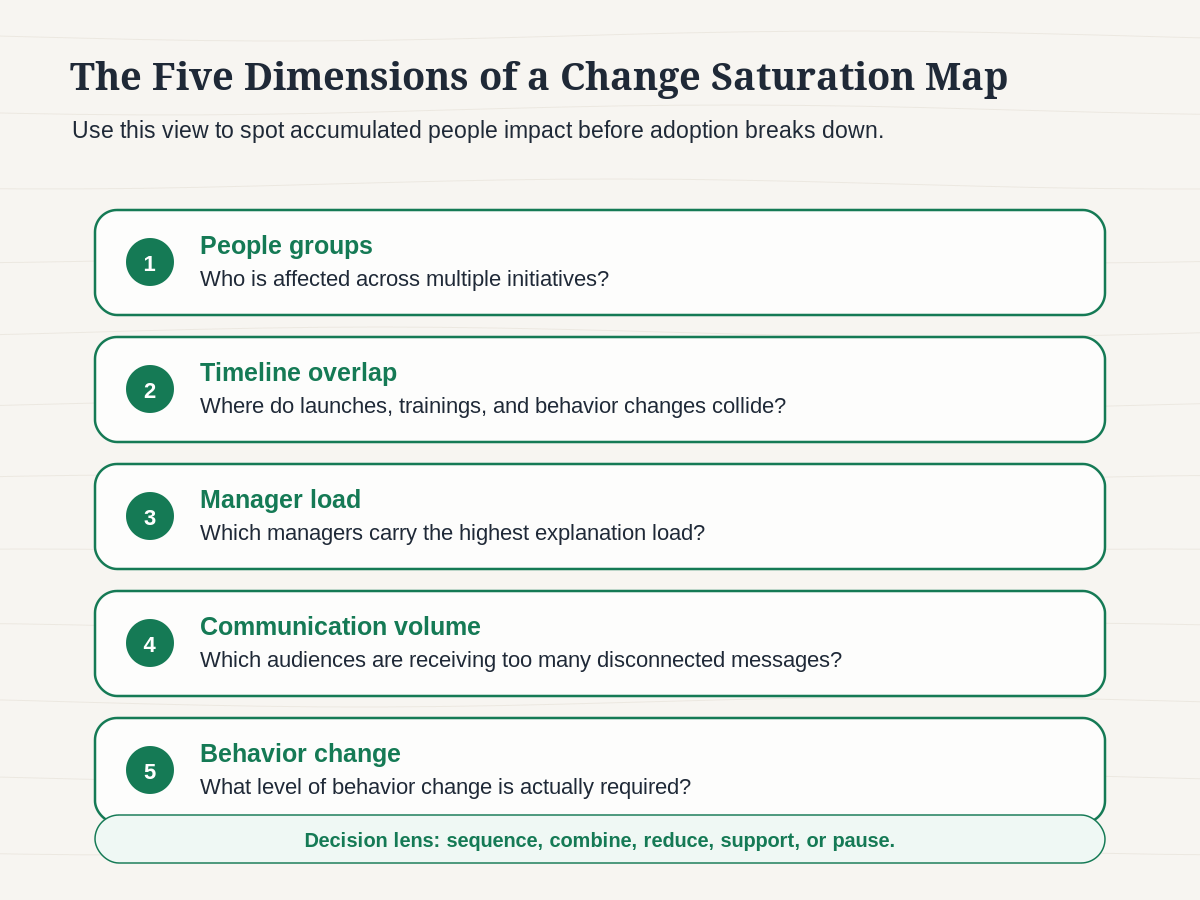 It is not a project plan, a communications calendar, or a stakeholder list. It is a people-impact view of transformation. The map should answer five questions.
1. Which people groups are affected?
Most transformation plans identify stakeholders, but they often do so within the boundaries of a single initiative. A saturation map looks across initiatives.
It asks:
- Which teams are affected by multiple changes?
- Which roles are being asked to learn new behaviors?
- Which employee groups are receiving the highest volume of communication?
- Which managers are expected to explain several changes at once?
- Which groups are being asked to change while also maintaining business continuity?
This matters because adoption happens locally. An initiative may be enterprise-wide on paper, but its burden is rarely distributed evenly. A finance transformation, AI rollout, and process redesign may all appear separate at the portfolio level. But they may all depend on the same middle managers, analysts, HR business partners, or frontline supervisors.
Those groups become the load-bearing points of transformation. If leaders cannot see that load, they cannot manage it.
2. Where do timelines overlap?
Most transformation calendars show launch dates and milestones. A saturation map shows collision points.
The question is not only, “When does this initiative launch?” The better questions are:
- What else launches that month?
- Which teams are in training at the same time?
- When are managers expected to communicate major updates?
- When do employees need to make decisions, change workflows, or adopt new tools?
- Which milestones create the most behavior change, not just the most project activity?
This distinction matters. A go-live date may be the project team’s finish line. But for employees, it may be the beginning of the hardest part. The work of adoption usually starts when the project dashboard turns green.
3. Where is manager load highest?
Managers are often the most underestimated constraint in transformation. They are expected to translate strategy into local meaning. They answer questions that were not addressed in the announcement. They absorb emotional reactions. They help teams decide what actually changes this week.
But many organizations treat managers as a distribution channel. They receive the deck. They attend the briefing. They are asked to cascade the message. That is not enough.
A saturation map should identify which managers are being asked to carry the most change at once.
Manager load includes:
- How many initiatives they need to explain.
- How much ambiguity they are expected to absorb.
- How many employee questions they need to answer.
- How much behavior change they need to coach.
- How many feedback loops they are expected to support.
When manager load is too high, transformation becomes inconsistent. Different teams receive different explanations. Local workarounds multiply. Resistance is detected late. Leaders lose signal. Managers are not just messengers. They are part of the adoption infrastructure.
4. How much communication volume is hitting the organization?
More communication does not always create more clarity. In saturated organizations, it often creates more noise.
A saturation map should show the communication load across audiences:
- How many announcements are employees receiving?
- How many channels are being used?
- How often are messages repeated without adding new clarity?
- Which groups are receiving broad updates that should have been tailored?
- Where are leaders relying on polished messaging instead of useful explanation?
This matters because message volume and message clarity are not the same thing. When employees hear too many disconnected or incomplete messages, they do not simply ask for more communication. They start discounting the communication they receive.
The goal is not to communicate more. The goal is to communicate in a way that helps each audience understand what the change means for them.
5. What level of behavior change is required?
Not all changes ask the same thing of people. Some changes require awareness. Some require understanding. Some require a new workflow. Some require a new habit. Some require a new identity or way of working.
A policy update and an operating-model redesign should not be treated as the same level of change just because both appear on a roadmap. The saturation map should distinguish between communication load and behavior-change load. A team may receive only a few messages, but those messages may require major changes in how work is done. Another team may receive many updates, but only minor action is required.
Leaders need to know the difference. The deeper the behavior change, the more support the organization needs.
The warning signs of change saturation
Change saturation rarely announces itself all at once. It shows up through patterns. Here are four signs leaders should watch for.
Teams cannot explain what matters most
When employees are asked about priorities and give five different answers, the issue may not be commitment. It may be saturation.
Too many changes are competing for attention. In that environment, people make their own hierarchy. They decide which changes matter, which ones can be delayed, and which ones are probably temporary. That informal prioritization may be rational. But it may not match leadership intent.
Managers start improvising
Improvisation is useful in small amounts. But when managers are consistently creating their own explanations, FAQs, and timelines, it usually means the change system is under-supported.
This creates uneven adoption. One team gets a clear explanation. Another team gets uncertainty. Another gets reassurance that later proves inaccurate. Another hears nothing until the change is unavoidable. The organization then mistakes inconsistency for resistance.
Employees comply without adopting
Saturated organizations can produce the appearance of progress. People attend training. They acknowledge the new policy. They log into the new system. They join the kickoff.
But the underlying behavior does not change. This is one of the most dangerous forms of transformation failure because the dashboard may look healthy while the operating reality stays the same. Adoption is not the same as exposure.
Sponsors keep adding messages
When a change is not landing, leaders often respond by communicating more. Another all-hands. Another email. Another slide. Another reminder. Sometimes that helps. Often, it adds to the saturation.
The issue may not be message frequency. The issue may be that the organization does not have enough specificity, sequencing, manager readiness, or audience-level clarity. A saturated organization does not need louder communication. It needs better orchestration.
How to use the Change Saturation Map
A useful Change Saturation Map should help leaders make decisions. It should not become another static artifact. Once leaders can see where change is accumulating, they have five options.
1. Sequence
Some initiatives do not need to stop. They need to move. Sequencing means adjusting timing so that the same people are not asked to absorb multiple high-effort changes at once. This is especially important when changes require new behaviors, not just awareness.
2. Combine
Sometimes separate initiatives should be explained together. If two changes affect the same audience and support the same strategic outcome, combining the narrative can reduce confusion. This does not mean merging project teams. It means helping employees understand the connection. People should not have to assemble the transformation story themselves.
3. Reduce
Some communication should be removed. Not every update deserves an enterprise announcement. Not every milestone needs a new message. Not every audience needs the same level of detail. Reducing communication volume can increase clarity when the remaining messages become more relevant.
4. Support
If a group is carrying a high change load, leaders may need to add support. That could mean manager talking points, office hours, job aids, team-specific FAQs, additional training, or a clearer escalation path. Support should follow load. The people absorbing the most change should not receive the same generic enablement as everyone else.
5. Pause
Sometimes the right move is to pause. That can feel uncomfortable in organizations that equate movement with progress. But pausing a lower-priority change may protect adoption for a higher-priority one.
The goal is not to slow transformation. The goal is to prevent transformation from becoming noise.
A practical diagnostic for leaders
Before launching the next initiative, ask:
- Which teams are already absorbing major change?
- Which managers are being asked to explain multiple initiatives?
- What other messages will this audience receive in the same period?
- What behavior change are we asking for, not just what awareness are we creating?
- Where might employees experience this as one more disconnected request?
- What needs to be sequenced, combined, reduced, supported, or paused?
The answers will not eliminate complexity. But they will make the complexity visible. And visible complexity is much easier to lead than invisible overload.
Transformation intelligence starts with seeing the load
Organizations will continue to change. AI adoption, operating model shifts, workforce redesign, process improvement, and technology modernization are not slowing down. But the organizations that execute change well will be the ones that understand how transformation is experienced by the people expected to carry it.
They will not manage change only by initiative. They will manage it by audience, timing, manager load, communication volume, and behavior change. That is the purpose of the Change Saturation Map.
Not to argue for less ambition. To create the conditions for adoption.
Because the question leaders need to ask is no longer just: What change are we trying to launch?
It is also: How much change is the organization already carrying?